OutoftheBox is the trade name for OutoftheBox Training & Consultancy, a not-for-profit social enterprise established in Sheffield in 2021. Registered company #13552676.
Wisdom – we take time to breathe, trusting in ourselves and in the process, listening out for wisdom and new insights as a story is told visually on cloth or in sand.
Wonder – we reflect on our feelings and play imaginatively with the metaphors of the story and the stories of our lives.
Wellbeing – we develop deeper understanding of and connection to ourselves and others as we journey in love.
OutoftheBox brings people together in a playful and refreshing, yet deep and purposeful way. It can be used anywhere that people want to think, talk, and connect more deeply. We help you rediscover the power of stories and play to open the imagination and awaken the soul.
OutoftheBox was developed during the Covid-19 pandemic, inspired by Tuula Valkonen’s workplace counselling method, Deep Talk, and Charlotte Mason’s philosophy of education. It emerged through a collaboration between people from across the world who wanted to find a better way to connect. Together, we created a tool that offers people the time and space to wonder and to play with their head, heart and hands – and be transformed in the process!
Our stories are simple and yet profound, drawing on wisdom from myths, legends, traditional tales, children’s literature and various faith traditions. The OutoftheBox process creates space for you to respond authentically whatever your personal beliefs or values, because it is through honest and authentic engagement that growth can come. In this way, OutoftheBox can be purely secular or deeply spiritual. We trust each person to know what they need and know what is their work to do.
We offer you OutoftheBox as a tool for you to use however you choose, and to serve the needs of your community in the way that is most appropriate for them. We offer our stories, but encourage you to develop your own. We supply beautiful storytelling materials, but love telling stories with whatever objects we find around us. We would love to share with you through our training courses what we have learned about how to use OutoftheBox, and we also look forward to what you can bring to help grow and develop the OutoftheBox movement.
Here are some places where OutoftheBox stories are already being told:
OutoftheBox is being used to offer relational spiritual care to older people, including those living with dementia. OutoftheBox sessions help older people feel loved and cared for and to find a greater sense of belonging in their community.
A growing number of Christians from a range of traditions believe that the contemplative way of OutoftheBox is helping them tune in to the inner promptings of the Holy Spirit. OutoftheBox enables people to respond authentically, helping them be aware of their feelings and encouraging critical thinking skills. Christians will recognise that Jesus mixed with all sorts of people and told stories about everyday things around him, opening up questions, speaking in metaphors and parables. He left people to interpret what his stories meant. In a similar style to the Ignatian tradition of Lectio Divina, the OutoftheBox method encourages Christians to look for and find God in everything, and imagine where they are in a story and wonder what that might mean for them.
OutoftheBox is helping strengthen relationships and improve wellbeing in communities. It is versatile, and applicable in a wide range of contexts such as drop-ins for vulnerable and homeless people, parenting groups, intergenerational Warm Hubs, community cafes, allotment societies, and youth groups.
OutoftheBox is creating a space for people from different religions to connect with each other. It brings people together and builds community by allowing them to share their experiences and feelings, and to understand each other.
OutoftheBox is creating space in the school day for children to question, to play with ideas and to think for themselves. It helps them explore their values and what really matters to them, and to learn to express their feelings while also hearing others’ points of view.
Trained professionals are using OutoftheBox to create a calm, safe and brave space as part of their therapy. Examples include life coaches, play therapists, counsellors and chaplains.
OutoftheBox is helping teams in the workplace to connect with each other, and to talk about their values and their priorities, issues and plans in a light-hearted and yet profound and insightful way. It increases team’s creativity and improves communication, empathy and resilience.
OutoftheBox is essentially a process, with a certain atmosphere that we purposefully and carefully curate. We recap the process at the start of most sessions:
Breathe
This is time away from the business of the day where we can slow down and be present. It is a way of contemplation. There is no pressure on you to say anything if you would prefer to be quiet. SIlence is fertile ground for self-awareness, creativity and new perspectives. Silence can be a route into rest.
Trust
We trust ourselves and each other to find the wisdom we need. We are all equals in the circle. There is confidentiality – we do not share what is not ours to share outside the group.
Listen
This is a place of dialogue. We listen actively and intentionally to understand and to give us the chance of seeing things afresh. We give ourselves space to think and process our thoughts before we speak.
Feel
We are attentive to the movements of our hearts. We are curious about what we feel drawn to, and what makes us feel like stepping back. We share as much as we want to about how we’re feeling; there’s no need to say anything if we don’t want to.
Wonder
This is a place to be curious and to let go of assumptions. Curiosity drives learning and discovery. There are no right or wrong answers as we explore possibilities and wonder about our response.
Play
We follow where the play leads us. If we stay open and playful then we may notice something new. The process is light and life-giving and can bring us new insights and awareness as we experiment and play.
Love
OutoftheBox is all about relationships – deepening our connection with ourselves, each other, the world and perhaps the Divine. It can be transformative.
The OutoftheBox Method
OutoftheBox can be shared with individuals or groups in sessions that last from 10 minutes to two or three hours. A full OutoftheBox session has the following structure, though this can be adapted to suit your circumstances:
Welcome
Building the circle to help everyone feel present and able to bring their whole selves to the session and so be ready for a story. This includes recapping our values to act as ground rules for the session.
Prepare
Setting out the materials in silence and stillness, to help people settle their minds and invite them into the story space.
Tell
Making careful and intentional use of our words and actions to tell the story, slowing down the pace, and opening it up to the imagination.
Wonder
Holding a brave space and offering prompts to invite people to reflect on their feelings and accept the contributions of others.
Play
Using the materials to help the group explore in more depth a topic that has arisen through the wondering and consider where they are in the story.
Respond
Offering time and permission for individuals to continue to explore their response; for example by creating new stories, painting, writing, dancing or walking.
Celebrate
Encouraging people to connect socially, often with a drink and/or some food as a threshold to move on from the session to the rest of the day
The OutoftheBox Offer
Membership Becoming a member of OutoftheBox gives you access to the members’ area of our website. This is where you will find our story library, dates and zoom links for our members’ chats and story development meetings, as well a library of articles and documents for further reading to support your continuing development in the art of OutoftheBox. Membership gives you the licence to use our OutoftheBox story scripts.
Training We offer Taster sessions online for an introductory experience of an OutoftheBox story and community play. We also offer in person Tasters and Discovery Days. Our core course is Explore OutoftheBox – two days experiencing and exploring the art of OutoftheBox. We playfully and creatively relax into stories together. Our model of learning is one of action-reflection, with time to experience the approach, reflect on the experiences and to practise the art of OutoftheBox. For experienced OutoftheBox storytellers we offer further training days where we help you to progress your skills and delve further into the use of Community Play,and how to write an OutoftheBox story.
Facilitation OutoftheBox enables people to connect in fresh and exciting ways and its contemplative approach can be a refreshing experience for teams. Our OutoftheBox mentors are able to help facilitate team meetings, lead team away days, as well as presenting talks or workshops. We also run retreats, giving you the chance to experience the refreshing nature of OutoftheBox sessions, as well as offering time for people’s own personal creative response. We can design a retreat to suit your needs, using a combination of stories, community play and personal response time.
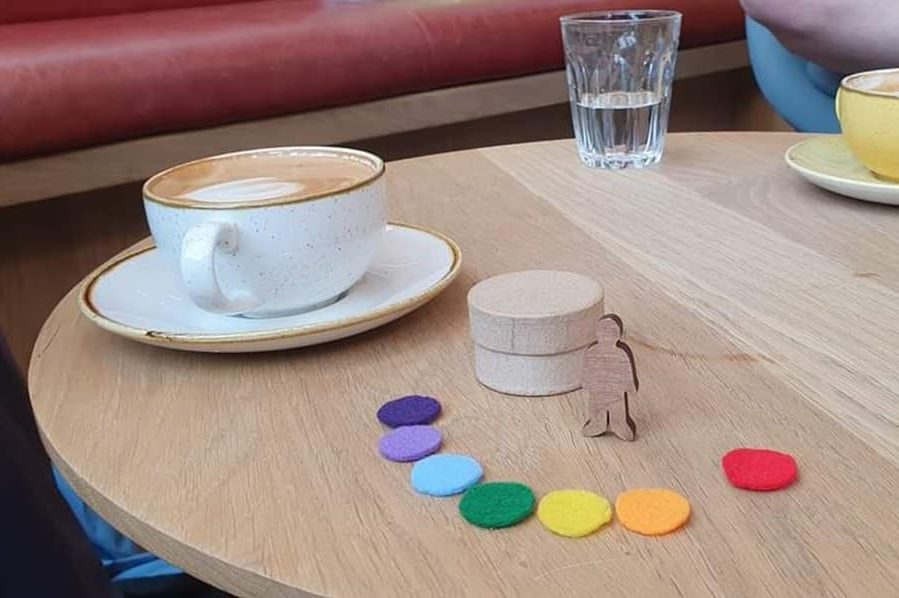
Materials OutoftheBox stories can be told with any found objects, but our online shop sells beautifully crafted materials for your storytelling. The OutoftheBox basket contains everything you need for all 49 Wisdom stories and more. Items can also be purchased separately.
Claire Pedrick MCC of 3D Coaching and The Coaching Inn, draws parallels between coaching and OutoftheBox:
“The coaching outlook which says trust the process and trust that the other person has what they need to do the work they need to do, echoes so strongly with my experience of using OutoftheBox storytelling to open up conversation. Both approaches advocate creating a container for the work which needs to be done in that moment. There is a recognition that this is what is needed in order for people to feel safe enough to be brave. As a facilitator/coach I notice this is what I need too, both these approaches support me in curbing my own inner desire to ‘sort it out’. There is a lightness to both types of conversation, maybe playfulness is another way of putting it. Even when we’re opening a space to talk about painful, complex or long-term entrenched situations, I find space for gentle smiles and loving humour in the conversations. We uncovered another way of changing the medium in coaching, exploring the value of ritual, embodied learning, and engaging even more of our senses.”